IN CELEBRATION OF MOZART’S BIRTHDAY, JANUARY 27, 1756
by Judith Eckelmeyer

(GRACE WOODS MUSIC SESSION JANUARY 29, 2024)
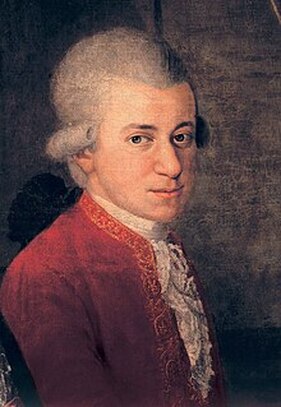
Portrait of Mozart, c. 1781
Mozart moved in 1781 from Salzburg to Vienna, where he was soon introduced to the music of J. S. Bach, whose work had largely been forgotten as music taste changed radically from Baroque counterpoint to the lighter style of the emerging classical style.
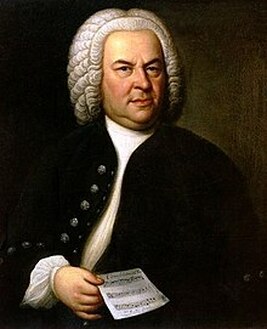
Johann Sebastian Bach, 1746
Mozart’s compositions from that time onward began to include elements and procedures he was so attracted to in Bach’s music, in particular the fugue and imitative techniques of counterpoint. In addition, elements that he had garnered only a few years earlier during his visit to Mannheim—effective use of expressive dynamics and the addition of the recently developed clarinet—formed the ground of his fully mature compositions.
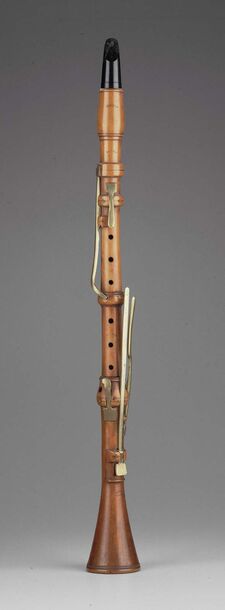
Clarinet in B-flat, c. 1780-90, made by Heinrich Carl Tolckle, Germany. Made of boxwood with an ebony mouthpiece.
He had already written a number of string quartets (2 violins, viola and cello), but with his new-found musical language, the quartets from 1782 onward achieved a depth of expression and richness of technique. In 1785 Mozart wrote six quartets (G, D minor, E-flat, B-flat, A, and C), each having his most sophisticated skills on display, and dedicated them to his friend and mentor, the eminent Franz Joseph Haydn (1832-1909).
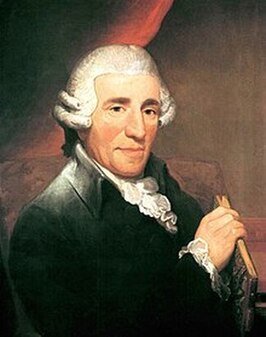
Portrait of Joseph Haydn by Thomas Hardy (1791)
Mozart’s dedicatory letter called these works his “sons”, entrusted to the care of his mentor. In February of 1785, Haydn was visiting Wolfgang and his father Leopold one evening in Vienna and heard three of these “new quartets”. In response, he declared to Leopold, “Before God and as an honest man I tell you that your son is the greatest composer known to me either in person or by name. He has taste and, what is more, the most profound knowledge of composition.” High praise from the most famous composer of the time!
The beginning of the last of these works, the “Dissonant” in C, K. 465, is the source of its nickname. In the slow introduction of the first movement, note piles upon note in astonishingly intense relationships that gradually unfold to the sunny Allegro in C major. That the confusion and darkness of the introduction emerge into “light” has singularly clear Masonic implications, which both Mozarts—father and son—and Haydn would recognize. The slow second movement is marked “Andante cantabile”. A lovely dialogue between first violin and cello and a recurring motive in the cello, eventually taken by the first violin, are notable features of the movement. In the third movement, which is, as expected, a minuet and trio, plays with sudden dynamic changes. In the trio the frequent “sigh” motifs complement the minor-key setting. The final movement has many Haydn-like features: pauses, unexpected key changes, and a generally playful character.
Mozart String Quartet No 19, K 465, ''Dissonant'' Alban Berg Quartet, 1978
If Haydn could be called the “father of the symphony”, we might think of Mozart as “father of the piano concerto”. His own professional history as a virtuoso performer on that instrument, recently improved and completely capable of expressive nuance, gave him a wealth of possibilities for creating new and remarkable concertos. The 27 concertos increasingly show off not only unabated innovations in thematic treatment, but also expanding means of expression for his own public performances of the works. The concerto in C major, numbered 21 (K. 467 of 1785), is interesting for several reasons. Its second movement is a lyrical beauty made famous in the movie “Elvira Madigan”, giving the 20th-century nickname to the concerto. But in addition, in other movements the attentive listener can detect themes Mozart used in other compositions. In the first movement, the piano suddently shifts to the minor key and presents a fragment of the opening theme he would use two years later in his G-minor symphony. Are there other connections between these two late works? Or other works? Hmmm…
Mozart Piano Concerto No 21, K 467 Yeol Eum Son
One of the most iconic of Mozart’s compositions, written two years after the C-major quartet and C-major concerto, is the G-minor symphony, no. 40 (K. 550).
Mozart: Symphony No. 40 in G minor K. 550 | CAMERATA Salzburg
It’s the middle work of the final triptych of Mozart’s symphonies. Their home keys are E-flat, G minor, and C. The triadic arch that they form is, I believe, highly significant: Mozart’s active involvement in Freemasonry bring to mind a pyramid, the number 3, and the content and musical styles which the three symphonies display. The first of the three, no. 39 (K. 543), begins with an Adagio “sunrise” and continues on as almost pastoral, innocent-sounding music. Its pleasingly untroubled construction suggests, in Masonic thinking, a “rough ashlar”, a “stone in the raw” as it were, with recognizable potential that is not yet developed.
Mozart Sinfonie nr 39 in Es-Dur KV 543 Neville Marriner
The second is a truly Sturm und Drang (Storm and Stress) work, as we’ll see below, subtly suggesting chaos, the dismantling of the traditional tonal pattern of usual compositions. The third shows a return to order, demonstrated first by its key clear of accidentals (Masonic “noon” at which there are the fewest shadows) and, even more, the contrapuntal treatment of themes, especially in the last movement. This contrapuntal texture is a musical metaphor for structural design, intelligent building, the successful outcome of careful labor, creating the Masonic “dressed ashlar”, the prepared stone for use in a building. Mozart had originally included two oboes in the orchestra, but later deleted the oboes and instead use 2 clarinets, which became one of the hallmarks of his Masonic music.
Let us review a bit. Mozart had become a 3rd-degree Mason (fully “entered”) in 1785 and used Masonic symbols in many and various ways in his compositions until his death in December of 1791. We have discussed previously the influence of stylistic developments on his work that introduced Sturm und Drang style into his toolbox, notably in the “little” G-minor symphony, no. 25, K. 183, in 1773.
Mozart: Sinfonie g-Moll KV 183 ∙ hr-Sinfonieorchester ∙ François Leleux
At that time, minor-key symphonies were very rare. It’s interesting that Mozart wrote 2 in his entire career (although there is a likely one discovered in Odense, Denmark, recently in a-minor); and there are only 2 minor-key piano concertos. Characteristics of this distinctive style:
|
Rhythmic agitation,
Unusual and abnormal structures, Wide-ranging melodic lines, Chromaticism, Interruptions in melodic lines, Sudden and unexpected changes in dynamics, Dissonances accented and prolonged, although eventually resolved, Ambiguity of key center or mode (major-minor). |
How and where do these show up in Mozart’s 40th? Here are some interesting moments:
Movement 1:
Opening in the minor with an agitated rhythm in the violas, accompanying a nervous half-step motive, followed by a wide leap, ending with a pause, as if gasping for breath;
More agitation in the transition to the second theme, before which is a measure of silence;
Second theme, innocent-sounding and untroubled (in B-flat major) has lots of “sigh” motives (falling half-steps);
Subsequent themes become progressively more active rhythmically;
The development uses the opening half-step motive to propel the harmony chromatically downward, the with contrapuntal struggle works upward against agitated countermelody; the melody is then slowly dismantled to a mere single half-step remnant;
The recapitulation returns everything to minor: the untroubled second theme is now sorrowful, and the agitated subsequent themes become increasingly foreboding;
The transition to the coda begins with sudden forte, then a sweeping upward chromatic scale leading to a leap up to----a sudden piano.
Movement 3:
This is, as expected, a minuet and trio. But the phrase lengths are truly unhinged.
Minuet: 3, 3, 3, 9 (repeated)/ 3, 3, 3, 7, 9, 3, 3 (repeated).
Trio: 2, 2, 2, 6, 2, 2 (repeated)/ 2, 2, 4, 2, 2, 2, 6, 2, 2 (repeated).
Remarkably, Mozart treats these phrases so subtly, so smoothly, that one is hardly aware of the odd structure at first.
Movement 4:
The transition between the exposition and development uses all but one of the 12 chromatic pitches, obscuring the sense of a home key.
Movement 1:
Opening in the minor with an agitated rhythm in the violas, accompanying a nervous half-step motive, followed by a wide leap, ending with a pause, as if gasping for breath;
More agitation in the transition to the second theme, before which is a measure of silence;
Second theme, innocent-sounding and untroubled (in B-flat major) has lots of “sigh” motives (falling half-steps);
Subsequent themes become progressively more active rhythmically;
The development uses the opening half-step motive to propel the harmony chromatically downward, the with contrapuntal struggle works upward against agitated countermelody; the melody is then slowly dismantled to a mere single half-step remnant;
The recapitulation returns everything to minor: the untroubled second theme is now sorrowful, and the agitated subsequent themes become increasingly foreboding;
The transition to the coda begins with sudden forte, then a sweeping upward chromatic scale leading to a leap up to----a sudden piano.
Movement 3:
This is, as expected, a minuet and trio. But the phrase lengths are truly unhinged.
Minuet: 3, 3, 3, 9 (repeated)/ 3, 3, 3, 7, 9, 3, 3 (repeated).
Trio: 2, 2, 2, 6, 2, 2 (repeated)/ 2, 2, 4, 2, 2, 2, 6, 2, 2 (repeated).
Remarkably, Mozart treats these phrases so subtly, so smoothly, that one is hardly aware of the odd structure at first.
Movement 4:
The transition between the exposition and development uses all but one of the 12 chromatic pitches, obscuring the sense of a home key.
Judith Eckelmeyer © 2024
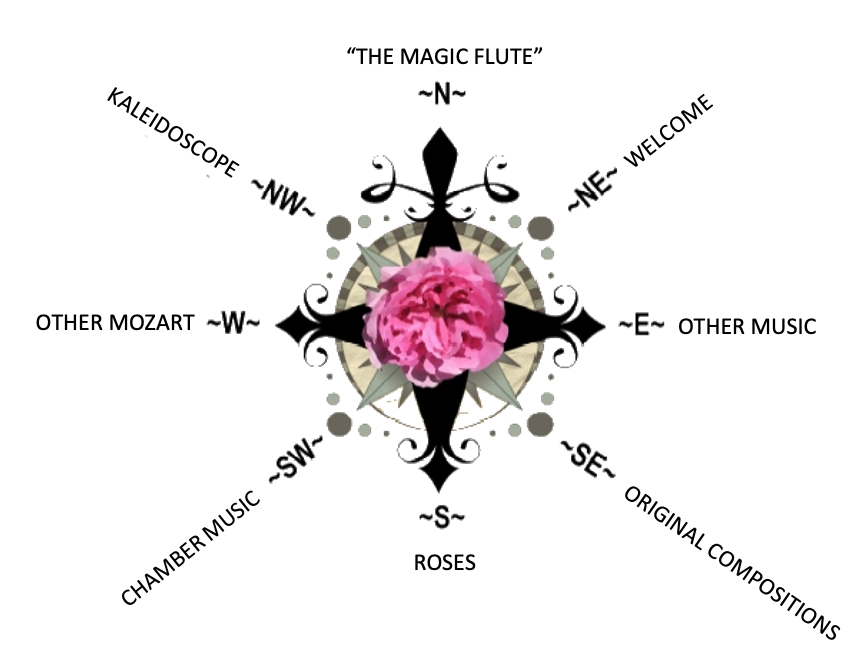
Choose Your Direction
The Magic Flute, II,28.

|
"(Die Liebe) mag den Weg mit Rosen streun, weil Rosen stets bei Dornen sein"
"(Love) may strew the path with roses, because roses always come with thorns" |

|