MOZART'S ROSES
  • Home
  • N - The Magic Flute
    • Magic Flute Overview Essay
    • Magic Flute Plot
    • Magic Flute Key Relationships
    • Magic Flute Original Production
    • Magic Flute Set and Costume Design
    • Magic Flute Set Inspirations
    • Magic Flute Legacy of Rosenkreuz
    • Magic Flute Freemasons and Rosicrucians
  • NE - Welcome!
  • E - Other Music
    • E - Music Genres >
      • 3 Lenten Works
      • A Few Little Words About the Motet
      • Facts and Fun about Madrigals
      • The Mass
      • Origins and Flourishing of the Concerto
      • What is a Requiem?
    • E - Composers >
      • Bartok: A Biography
      • Haydn: A Tribute
      • Schubert
    • E - Extended Discussions >
      • Allegri: Miserere
      • Bach: Cantata 4
      • Bach: Cantata 8
      • Bach: Chaconne in D minor
      • Bach: Concerto for Violin and Oboe
      • Bach: Motet 6
      • Bach: Passion According to St. John
      • Bach: Prelude and Fugue in B-minor
      • Bartok: String Quartets
      • Brahms: A German Requiem
      • David: The Desert
      • Durufle: Requiem
      • Faure: Cantique de Jean Racine
      • Faure: Requiem
      • Handel: Christmas Portion of Messiah
      • Haydn: Farewell Symphony
      • Liszt: Évocation à la Chapelle Sistine"
      • Poulenc: Gloria
      • Poulenc: Quatre Motets
      • Villa-Lobos: Bachianas Brazilieras
      • Weill
    • E - Grace Woods >
      • Grace Woods: 10-12-26
      • Grace Woods: 8-17-26
      • Grace Woods: 6-22-26
      • Grace Woods: 5-25-26
      • Grace Woods: 4-23-26
      • Grace Woods: 4-6-26
      • Grace Woods: 2-16-26
      • Grace Woods: 11-17-25
      • Grace Woods: 10-20-25
      • Grace Woods: 9-22-25
      • Grace Woods: 6-24-25
      • Grace Woods: 6-7-25
      • Grace Woods: 5-19-25
      • Grace Woods: 5-5-25
      • Grace Woods: 4-7-25
      • Grace Woods: 3-24-25
      • Grace Woods: 3-10-25
      • Grace Woods: 1-13-25
      • Grace Woods: 12-9-24
      • Grace Woods: 11-18-24
      • Grace Woods: 10-21-24
      • Grace Woods: 10-7-24
      • Grace Woods: 9-16-24
      • Grace Woods: 8-26-24
      • Grace Woods: 4-29-24
      • Grace Woods: 2-19-24
      • Grace Woods: 1-29-24
      • Grace Woods: 1-8-24
      • Grace Woods: 12-3-23
      • Grace Woods: 11-20-23
      • Grace Woods: 10-30-23
      • Grace Woods: 10-9-23
      • Grace Woods: 9-11-23
      • Grace Woods: 8-28-23
      • Grace Woods: 7-31-23
      • Grace Woods: 6-5-23
      • Grace Woods: 5-19-25
      • Grace Woods: 5-8-23
      • Grace Woods: 4-17-23
      • Grace Woods: 3-27-23
      • Grace Woods: 1-16-23
      • Grace Woods: 12-12-22
      • Grace Woods: 11-21-2022
      • Grace Woods: 10-31-2022
      • Grace Woods: 10-2022
      • Grace Woods: 9-6 & 9-9-21
      • Grace Woods: 8-29-22
      • Grace Woods: 8-8-22
      • Grace Woods: 5-2022
      • Grace Woods: 12-21
      • Grace Woods: 6-2021
      • Grace Woods: 5-2021
    • E - Trinity Cathedral >
      • Program Notes: 11-20-09
      • Program Notes: 11-16-12
      • Program Notes: 4-18-14
      • Program Notes: 11-21-14
      • Program Notes: 4-3-15
      • Program Notes: 3-25-16
      • Program Notes: 4-14-17
  • SE - Original Compositions
    • "Sarum Prayer"
    • Trinity "Hodie" Service
    • "Peace I Leave With You"
    • "The Road Not Taken"
    • "Epiphany"
  • S - Roses
    • Introduction
    • Sources for Old Roses
    • Useful and Interesting Rose Books
    • Around the Garden
    • 2012 Rose Garden
    • BOURBON
    • CENTIFOLIA
    • DAMASK
    • FLORIBUNDA
    • GROUND
    • HYBRID MUSK
    • HYBRID PERPETUAL
    • NOISETTE
    • OLD SHRUB
    • PIMPINELLIFOLIA HYBRID
    • POLYANTHA
    • PORTLAND
    • RUGOSA
  • SW - Chamber Music
    • 12/93 The Shostakovich Trio
    • 10/93 London Baroque
    • 3/93 Australian Chamber Orchestra
    • 2/93 Arcadian Academy
    • 1/93 Ilya Itin
    • 10/92 The Cleveland Octet
    • 4/92 Shura Cherkassky
    • 3/92 The Castle Trio
    • 2/92 Paris Winds
    • 11/91 Trio Fontenay
    • 2/91 Baird & DeSilva
    • 4/90 The American Chamber Players
    • 2/90 I Solisti Italiana
    • 1/90 The Berlin Octet
    • 3/89 Schotten-Collier Duo
    • 1/89 The Colorado Quartet
    • 10/88 Talich String Quartet
    • 9/88 Oberlin Baroque Ensemble
    • 5/88 The Images Trio
    • 4/88 Gustav Leonhardt
    • 2/88 Benedetto Lupo
    • 9/87 The Mozartean Players
    • 11/86 Philomel
    • 4/86 The Berlin Piano Trio
    • 2/86 Ivan Moravec
    • 4/85 Zuzana Ruzickova
  • W - Other Mozart
    • Mozart: 1777-1785
    • Mozart: 235th Commemoration
    • Mozart: Ave Verum Corpus
    • Mozart: Church Sonatas
    • Mozart: Clarinet Concerto
    • Mozart: Don Giovanni
    • Mozart: Exsultate, jubilate
    • Mozart: Magnificat from Vesperae de Dominica
    • Mozart: Mass in C, K.317 "Coronation"
    • Mozart: Masonic Funeral Music,
    • Mozart: Requiem
    • Mozart: Requiem and Freemasonry
    • Mozart: Sampling of Solo and Chamber Works from Youth to Full Maturity
    • Mozart: Sinfonia Concertante in E-flat
    • Mozart: String Quartet No. 19 in C major
    • Mozart: Two Works of Mozart: Mass in C and Sinfonia Concertante
  • NW - Kaleidoscope
    • Whimsy >
      • Egg Art
      • Exceptional Artifacts
      • Garden Ephemera
      • Musical Rarities
      • Nature
      • Reading Recommendations
      • Travel
    • Alfred Whittaker Introduction >
      • Alfred Whittaker CV
      • Alfred Whittaker Essays
    • Multidisciplinarity in Education and Research
  • Contact

Topaz Jewel

FRANZ SCHUBERT AND ANTONIN DVOŘÁK

By Judith Eckelmeyer
Picture
(GRACE WOODS MUSIC SESSION OCTOBER 12, 2026)

Picture
Franz Schubert 1875 portrait, after an 1825 original
Born in Vienna in 1727, Franz Schubert was 17 years Ludwig van Beethoven’s junior. By the power of his reputation, his musical genius, his musical innovations, his intensity—which flowed through his compositions--Beethoven’s presence dominated Schubert’s consciousness until virtually the day he died in 1828. In all regards, Beethoven inhabited Schubert’s compositional thinking. But Beethoven died in 1827, and in his last year Schubert was in a sense working in the spirit of the Giant whom he had revered all his life. But Schubert was definitely not a well man. From 1822 he suffered several bouts of severe illness, one necessitating his hospitalization in 1823. In spite of periods of apparent health, with support of his brother and his friends, respite in the countryside, and unending creativity, he suffered a number of maladies, joined by depression, especially from the fall of 1827. (One can imagine the effect of the texts of some of his Lieder at this time: the disheartening cycle Die Winterreise (The Winter Journey), for example.) In contrast, though, a number of his compositions that year were upbeat, if not triumphant: Miriams Siegesgesang (Miriam’s Song of Victory) and Der Hirt auf dem Felsen (The Shepherd on the Rock), for example, or the Great C-Major Symphony. Reading through a list of the last year’s compositions, one would have no particular inkling of the composer in serious ill health. ​
Schubert ‐ Mirjams Siegesgesang, D942
​Franz Schubert: Der Hirt auf dem Felsen - Anna Lucia Richter/Ensemble der KammerMusikKöln
Among the works Schubert created in that last year were his final three piano sonatas: D 958 in C Minor, D 959 in A, and D 560 in B-flat. (“D” refers to Otto Erich Deutsch, the musicologist who created the catalog system for Schubert’s work in 1951.) These three sonatas are very different from the early sonatas, which seem light and in the style of an earlier era. Indeed, many commentators see in these sonatas many characteristics of music that would come later in the century and be perceived as expressions of late Romanticism. It is as though Schubert channeled Beethoven’s great explorations in his late works and forged new ways of devising a “sonata” for the piano, as if creating memorials to his great predecessor.
​Schubert - Piano Sonata No. 19 in C Minor, D.958
Wilhelm Kempff, piano
Now, Schubert did not invent a new procedure for a sonata but based his last three in the classical model of four movements, fast-slow-scherzo-fast. Very typical. But the contents of each movement are certainly much influence by Beethoven’s late style rather than Mozart’s. There are vast contrasts in each—texture, key, pianistic style, exploitation of the piano’s range and dynamic possibilities and varieties of touch. These contrasts occur at seemingly blinding speed. Yet each movement has its own aura. The first, with vigorous sections morphing into more serene passages, has the dynamism of late Beethoven. The second, more meditative for the most part, suggests to me moment of reflection, perhaps Schubert’s remembrance of Beethoven. The third is a scherzo, which moves very quickly into the fourth movement which has the rhythm of a tarantella. It takes a master artist to achieve all the nuances and well, convincingly, musically.
Speaking of which, our recording of the first of the three sonatas, in C minor, is by Mitsuko Uchida, a Japanese-English virtuoso much honored in the music world. Born in 1947 near Tokyo, she joined her parents, who were diplomats when they were appointed ambassadors to Vienna. She studied in Vienna with Wilhelm Kempff, among others. She moved to England where she continued her piano career, entering competitions beginning in 1968; she not only won major prizes and was appointed Honorary Commander of the Order of the British Empire in 2001 and, after becoming a British citizen, she was promoted to Dame Commander of the Order of the British Empire in 2009. Her performances in Cleveland as soloist-conductor of TCO have made her a welcome presence here, where she performed/led Mozart concertos from the piano. She is widely recognized for her performances of Beethoven and Schubert and works of the Second Viennese School. There’s so much more in the way of honors and prizes, you might enjoy reading about her online.
Picture
Mitsuko Uchida
And now some full disclosure: although I have studied, heard, and performed Schubert’s music, there’s a ton of it I have not gotten to know. It’s an occupational hazard. It’s nearly impossible to work on so many of Schubert’s compositions. His piano and chamber music are largely out of my perview, except when, like now, I delve into a special composition in either of those two genres. After all, Schubert was a prolific composer, much like Bach. The list of his works runs into the upper 990’s. A great portion of these are Lieder—songs for voice and piano and sometimes other instruments. But there are sacred works (six Mass settings and others), choral works for men or mixed-voice choir, chamber works such as string quartets or quintets, a few stage works (who knew??), and did I mention symphonies? 
​
In any case, I would suggest you sit back, enjoy Uchida’s performance and the music you’ll hear from Schubert.

Picture
Dvořák in 1882
Antonín Dvořák (1841-1904) was born in Bohemia, a region of the Czech lands at the time a part of the Austrian Empire. Besides his study of organ, music theory and music of major composers, he daily heard national songs and saw dances of his homeland and, of course, absorbed them as a talented youth. These became the basis of much of his early composition, which began while he was a student in Prague. His music was recognized locally, but he sought recognition more widely and entered competitions in Germany and Austria. It so happened the none other than Johannes Brahms was on the jury for the Austrian State Competition, which he won, in 1874; he won a third time in 1877, and Brahms recommended him to his own publisher, Simrock. This resulted the publishers commissioning a series of pieces based on Dvořák’s regional background which became the first set of Slavonic Dances. The international success of this music launched his career. ​
​Dvořák - Slavonic Dances, Op 46 - Kocsis
After a distinguished career as a prolific composer of his homeland’s national dances, 11 string quartets, a violin concerto, and seven symphonies (and more!), as an organist and viola player in theater orchestras in Prague, Dvořák experienced anti-Czech feeling in Prague. His music’s success in performances in England was stymied again by anti-Czech attitudes, but the aftermath opened another chapter in his life: a three-year stay in the United States (1892-1895) as director of the National Conservatory of Music in New York City. The president of the Conservatory, Jeannette Thurber, provided a very generous annual salary, which, owing to the Panic of 1893 and severe economic depression, required a great diminution of his salary. However, the Conservatory offered him the opportunity to see a progressive institution which was open to women and Black students. He encountered “American Music” and met Harry Burleigh, an African-American singer who introduced him to African-American spirituals; in addition, his consciousness of “other” musics was expanded to consider music of the Native Americans, both of which he thought could and should become basis for developing music in America. One thing led to another, with the triumphant conclusion of his composition of the 9th symphony, from the New World in 1893.
​Dvořák: Symphony No. 9 From the New World | Paavo Järvi and the Tonhalle-Orchester Zürich
As fate would have it, Dvořák’s secretary, Josef Jan Kovařik was a Czech-American violinist who had recently finished studies at the Prague Conservatory. His hometown was Spillville, Iowa, a small community settled by Czech immigrants. (Never heard of Spillville? It’s in the north-east, very close to the Minnesota border, seemingly in the middle of nowhere if you’re looking at a map, with rolling hills and arable land. The community continues to this day.) Dvořák decided to take his annual summer vacation with his family in Spillville. This was perhaps his happiest time in America.
Picture
Antonín Dvořák in Spillville
While in this idyllic setting, Dvořák composed his String Quartet No. 12 in F, Op. 96, which he named the “American” Quartet, and the 9th symphony, works greatly influenced by Native American and African-American music, also showing features of his native Czech music. A prominent element is the five-note (pentatonic) scale common to all three resources.  ​
​Dvořák: Quartet No.12 in F major for Strings, Op. 96, “The American” (1893) 
Cast in the traditional classical 4-movements, this quartet is basically a very happy work. The first movement glows with the warmth of the opening viola solo and continues on in a “pastoral” mood.                                
The second movement is deep, reflective, even nostalgic (was Dvořák homesick at the time, surrounded as he was by Czech-speaking folk yet not his “homies”?)

​The third movement, a scherzo in a typical dance style, has in it a bird call (scarlet tanager) which Dvořák heard on a walk in the Iowa woods.

The last movement is “a joyful, ebullient rondo” bringing the work to “a high-spirited close” (Wikipedia).

The recording of this quartet was performed by the Guarneri Quartet, widely honored for numerous performances of a wide-ranging roster of composers. 

​I hope you’ll enjoy the music!​
Judith Eckelmeyer ©2026

Choose Your Direction
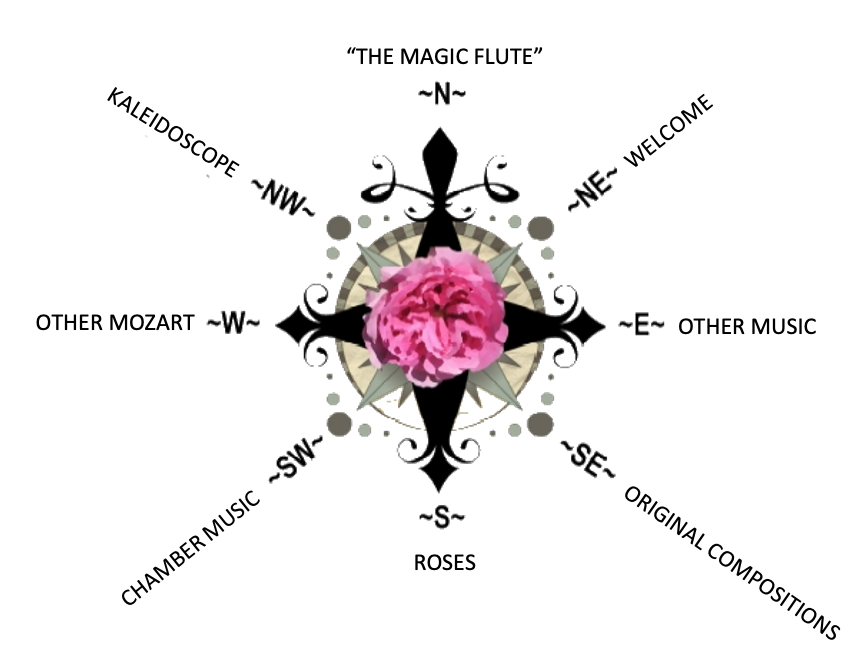
NORTHWEST - Kaleidoscope


WEST - Other Mozart


SOUTHWEST - Chamber Music

NORTH - The Magic Flute
Picture
SOUTH - Roses


NORTHEAST - Welcome!


EAST - Other Music


SOUTHEAST - Original Compositions

HOME - Website Introduction
​
CONTACT- Judith Eckelmeyer

The Magic Flute, II,28.
Picture
"(Die Liebe) mag den Weg mit Rosen streun, weil Rosen stets bei Dornen sein"
"(Love) may strew the path with roses, because roses always come with thorns"
Picture
  • Home
  • N - The Magic Flute
    • Magic Flute Overview Essay
    • Magic Flute Plot
    • Magic Flute Key Relationships
    • Magic Flute Original Production
    • Magic Flute Set and Costume Design
    • Magic Flute Set Inspirations
    • Magic Flute Legacy of Rosenkreuz
    • Magic Flute Freemasons and Rosicrucians
  • NE - Welcome!
  • E - Other Music
    • E - Music Genres >
      • 3 Lenten Works
      • A Few Little Words About the Motet
      • Facts and Fun about Madrigals
      • The Mass
      • Origins and Flourishing of the Concerto
      • What is a Requiem?
    • E - Composers >
      • Bartok: A Biography
      • Haydn: A Tribute
      • Schubert
    • E - Extended Discussions >
      • Allegri: Miserere
      • Bach: Cantata 4
      • Bach: Cantata 8
      • Bach: Chaconne in D minor
      • Bach: Concerto for Violin and Oboe
      • Bach: Motet 6
      • Bach: Passion According to St. John
      • Bach: Prelude and Fugue in B-minor
      • Bartok: String Quartets
      • Brahms: A German Requiem
      • David: The Desert
      • Durufle: Requiem
      • Faure: Cantique de Jean Racine
      • Faure: Requiem
      • Handel: Christmas Portion of Messiah
      • Haydn: Farewell Symphony
      • Liszt: Évocation à la Chapelle Sistine"
      • Poulenc: Gloria
      • Poulenc: Quatre Motets
      • Villa-Lobos: Bachianas Brazilieras
      • Weill
    • E - Grace Woods >
      • Grace Woods: 10-12-26
      • Grace Woods: 8-17-26
      • Grace Woods: 6-22-26
      • Grace Woods: 5-25-26
      • Grace Woods: 4-23-26
      • Grace Woods: 4-6-26
      • Grace Woods: 2-16-26
      • Grace Woods: 11-17-25
      • Grace Woods: 10-20-25
      • Grace Woods: 9-22-25
      • Grace Woods: 6-24-25
      • Grace Woods: 6-7-25
      • Grace Woods: 5-19-25
      • Grace Woods: 5-5-25
      • Grace Woods: 4-7-25
      • Grace Woods: 3-24-25
      • Grace Woods: 3-10-25
      • Grace Woods: 1-13-25
      • Grace Woods: 12-9-24
      • Grace Woods: 11-18-24
      • Grace Woods: 10-21-24
      • Grace Woods: 10-7-24
      • Grace Woods: 9-16-24
      • Grace Woods: 8-26-24
      • Grace Woods: 4-29-24
      • Grace Woods: 2-19-24
      • Grace Woods: 1-29-24
      • Grace Woods: 1-8-24
      • Grace Woods: 12-3-23
      • Grace Woods: 11-20-23
      • Grace Woods: 10-30-23
      • Grace Woods: 10-9-23
      • Grace Woods: 9-11-23
      • Grace Woods: 8-28-23
      • Grace Woods: 7-31-23
      • Grace Woods: 6-5-23
      • Grace Woods: 5-19-25
      • Grace Woods: 5-8-23
      • Grace Woods: 4-17-23
      • Grace Woods: 3-27-23
      • Grace Woods: 1-16-23
      • Grace Woods: 12-12-22
      • Grace Woods: 11-21-2022
      • Grace Woods: 10-31-2022
      • Grace Woods: 10-2022
      • Grace Woods: 9-6 & 9-9-21
      • Grace Woods: 8-29-22
      • Grace Woods: 8-8-22
      • Grace Woods: 5-2022
      • Grace Woods: 12-21
      • Grace Woods: 6-2021
      • Grace Woods: 5-2021
    • E - Trinity Cathedral >
      • Program Notes: 11-20-09
      • Program Notes: 11-16-12
      • Program Notes: 4-18-14
      • Program Notes: 11-21-14
      • Program Notes: 4-3-15
      • Program Notes: 3-25-16
      • Program Notes: 4-14-17
  • SE - Original Compositions
    • "Sarum Prayer"
    • Trinity "Hodie" Service
    • "Peace I Leave With You"
    • "The Road Not Taken"
    • "Epiphany"
  • S - Roses
    • Introduction
    • Sources for Old Roses
    • Useful and Interesting Rose Books
    • Around the Garden
    • 2012 Rose Garden
    • BOURBON
    • CENTIFOLIA
    • DAMASK
    • FLORIBUNDA
    • GROUND
    • HYBRID MUSK
    • HYBRID PERPETUAL
    • NOISETTE
    • OLD SHRUB
    • PIMPINELLIFOLIA HYBRID
    • POLYANTHA
    • PORTLAND
    • RUGOSA
  • SW - Chamber Music
    • 12/93 The Shostakovich Trio
    • 10/93 London Baroque
    • 3/93 Australian Chamber Orchestra
    • 2/93 Arcadian Academy
    • 1/93 Ilya Itin
    • 10/92 The Cleveland Octet
    • 4/92 Shura Cherkassky
    • 3/92 The Castle Trio
    • 2/92 Paris Winds
    • 11/91 Trio Fontenay
    • 2/91 Baird & DeSilva
    • 4/90 The American Chamber Players
    • 2/90 I Solisti Italiana
    • 1/90 The Berlin Octet
    • 3/89 Schotten-Collier Duo
    • 1/89 The Colorado Quartet
    • 10/88 Talich String Quartet
    • 9/88 Oberlin Baroque Ensemble
    • 5/88 The Images Trio
    • 4/88 Gustav Leonhardt
    • 2/88 Benedetto Lupo
    • 9/87 The Mozartean Players
    • 11/86 Philomel
    • 4/86 The Berlin Piano Trio
    • 2/86 Ivan Moravec
    • 4/85 Zuzana Ruzickova
  • W - Other Mozart
    • Mozart: 1777-1785
    • Mozart: 235th Commemoration
    • Mozart: Ave Verum Corpus
    • Mozart: Church Sonatas
    • Mozart: Clarinet Concerto
    • Mozart: Don Giovanni
    • Mozart: Exsultate, jubilate
    • Mozart: Magnificat from Vesperae de Dominica
    • Mozart: Mass in C, K.317 "Coronation"
    • Mozart: Masonic Funeral Music,
    • Mozart: Requiem
    • Mozart: Requiem and Freemasonry
    • Mozart: Sampling of Solo and Chamber Works from Youth to Full Maturity
    • Mozart: Sinfonia Concertante in E-flat
    • Mozart: String Quartet No. 19 in C major
    • Mozart: Two Works of Mozart: Mass in C and Sinfonia Concertante
  • NW - Kaleidoscope
    • Whimsy >
      • Egg Art
      • Exceptional Artifacts
      • Garden Ephemera
      • Musical Rarities
      • Nature
      • Reading Recommendations
      • Travel
    • Alfred Whittaker Introduction >
      • Alfred Whittaker CV
      • Alfred Whittaker Essays
    • Multidisciplinarity in Education and Research
  • Contact